
When designing a laser-cut component, one of the most important questions is:
How small can the hole be?
The answer depends on several factors, including material type, material thickness, laser technology, cutting parameters, hole geometry, and the tolerance required.
A laser can produce very small holes, but making a hole physically possible to cut does not necessarily mean it will produce a good-quality, dimensionally accurate hole.
For engineers, the goal is to specify a hole size that the laser cutting process can produce consistently.
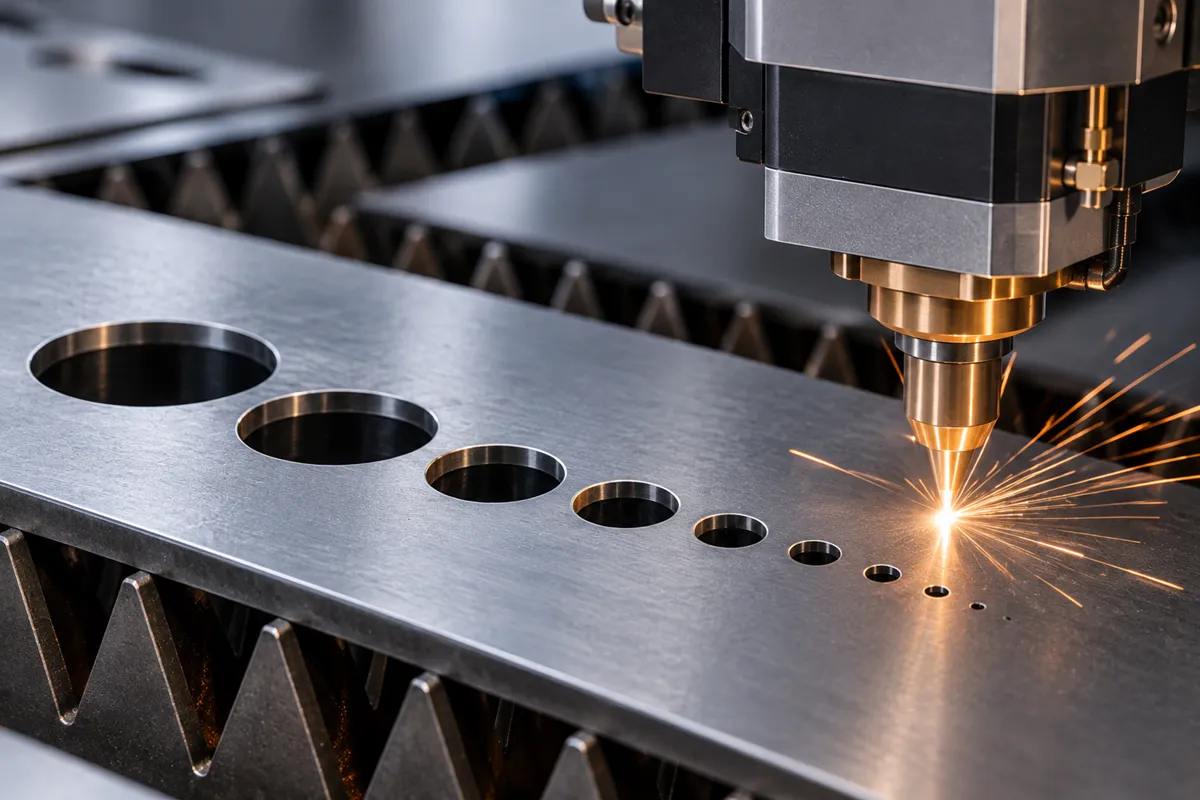
What Is the Minimum Hole Size for Laser Cutting?
There is no single minimum hole diameter that applies to every laser-cutting application.
As a general design principle, the minimum practical hole diameter is related to the material thickness.
A small hole in thin sheet may be relatively easy to produce, while the same hole in a thick plate can result in poor edge quality, taper, distortion, or incomplete cutting.
For many applications, engineers use the hole diameter-to-material-thickness ratio as an initial design consideration.
A commonly used guideline is:
Hole diameter should generally be equal to or greater than the material thickness.
For example, if the material is 3 mm thick, a hole around 3 mm or larger is generally more practical than a 1 mm hole.
This is only a design guideline, not a universal specification. Actual capability depends on the laser machine, material, thickness, and required quality.
Why Does Material Thickness Affect Hole Size?
As material thickness increases, the laser must travel through a greater depth of material.
This can affect:
- Heat distribution
- Beam stability
- Cutting speed
- Kerf
- Hole roundness
- Edge quality
- Taper
- Dimensional accuracy
A hole that cuts cleanly in a thin sheet may not produce the same result in a thick plate.
This is why minimum hole size should always be considered together with material thickness.
How Small a Hole Can a Laser Cut?
The practical minimum depends on the specific application.
For example, producing a small hole in 1 mm stainless steel is very different from producing the same hole in 10 mm mild steel.
The following factors should be considered before specifying a very small hole:
| Factor | Effect on Minimum Hole Size |
|---|---|
| Material thickness | Thicker material generally requires larger holes |
| Material type | Different materials respond differently to laser cutting |
| Hole diameter | Smaller holes are more sensitive to cutting conditions |
| Laser power | Determines the machine’s cutting capability |
| Cutting speed | Influences heat input and edge quality |
| Assist gas | Affects molten-material removal |
| Tolerance | Tighter dimensions may require a larger practical feature |
| Production quantity | Repeatability becomes more important for larger batches |
If the hole is functionally critical, the supplier should review the drawing before production.
What Happens When a Hole Is Too Small?
Trying to cut a hole that is too small for the material thickness can cause several problems.
Poor Hole Roundness
The hole may not remain perfectly circular because the laser has limited space to complete the cutting path.
Tapered Edges
The top and bottom of the hole may have slightly different dimensions, particularly in thicker materials.
Excessive Heat
A very small feature can concentrate heat in a small area, potentially affecting dimensional accuracy and edge quality.
Dross
Molten material may not be removed cleanly from the bottom of the cut, resulting in dross.
Dimensional Variation
Small holes can be more sensitive to changes in material condition and cutting parameters.
For components that require accurate holes for assembly, these issues can become important.
Does Laser Kerf Affect Hole Size?
Yes.
During laser cutting, a small amount of material is removed by the laser beam. This removed width is called the kerf.
For larger profiles, kerf compensation can be incorporated into the cutting process. However, when a hole becomes very small relative to the kerf and material thickness, maintaining the intended geometry becomes more difficult.
This is one reason why a hole that looks perfectly acceptable in CAD may require additional consideration before production.
Minimum Hole Size for Different Materials
The practical minimum hole size varies by material and thickness.
Mild Steel
Mild steel is commonly laser cut across a wide range of thicknesses. Small holes can be produced in thin sheet, while thicker plate generally requires larger hole diameters for good quality.
Stainless Steel
Stainless steel can produce excellent laser-cut results, but small features still need to be evaluated against thickness and required tolerance.
Aluminium
Aluminium’s thermal characteristics make cutting parameters particularly important when producing small holes.
Other Metals
Copper, brass, and other reflective materials can require specialized laser equipment and process parameters.
For this reason, a supplier should confirm the minimum practical hole size based on the exact material grade and thickness, rather than providing one number for every application.
Laser Cutting or Drilling for Small Holes?
Laser cutting is often an excellent choice for holes that are within the practical capability of the process.
However, if you require extremely small or highly accurate holes, another process may be more appropriate.
For example:
Laser cutting → CNC drilling → Reaming
may be preferable when the hole requires:
- Very tight dimensional tolerance
- High roundness
- Precision fit
- Accurate diameter
- Controlled surface finish
Using laser cutting for the overall profile and machining only the critical holes can often provide a good balance between production speed and precision.
How Engineers Should Design Holes for Laser Cutting
Before finalizing your CAD drawing, consider:
1. Material thickness
Make sure the hole diameter is appropriate for the thickness.
2. Hole tolerance
Don’t specify unnecessarily tight tolerances for non-critical holes.
3. Hole function
A clearance hole and a precision bearing hole have very different requirements.
4. Distance between holes
Closely spaced holes can create localized heat and affect the surrounding material.
5. Distance from the edge
Very small holes positioned close to an edge may affect both cutting quality and part strength.
6. Required quantity
For production batches, repeatability is just as important as producing one acceptable prototype.
What Should You Send to a Laser Cutting Supplier?
When requesting a quotation, provide:
- Material grade
- Material thickness
- Quantity
- CAD file
- Engineering drawing
- Hole dimensions
- Hole tolerances
- Critical dimensions
- Required secondary operations
If a hole is critical for assembly, clearly identify it on the drawing.
A good laser cutting supplier should be able to review the design and tell you whether the specified hole can be produced reliably.
Need Small, Accurate Holes in Laser-Cut Parts?
The minimum hole size is not determined by the laser alone. It depends on the complete combination of material, thickness, machine capability, cutting parameters, geometry, and tolerance requirements.
If you have a component with small holes or other critical features, send us your CAD drawing, material, thickness, and quantity.
Our team can review the design, check its laser-cutting feasibility, and provide a quotation for your requirement.
Have a drawing ready? Send it to us for a laser cutting quotation.