
Getting a laser cutting quote is straightforward when you provide the right information. A complete drawing, correct material details, and required quantity allow a laser cutting supplier to calculate the job accurately without unnecessary back-and-forth.
If you are preparing parts for manufacturing, here is what you should provide to get an accurate laser cutting quotation.
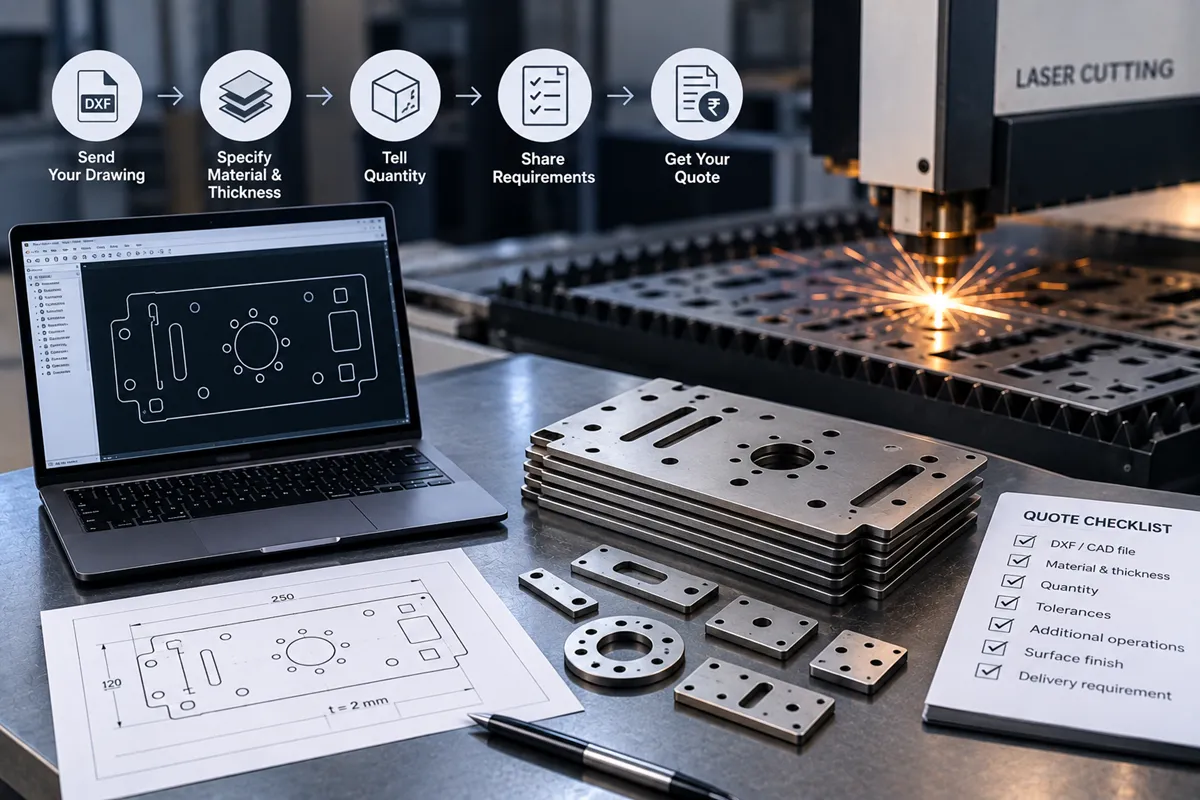
Information Required for a Laser Cutting Quote
| Information | Example | Why It Is Required |
|---|---|---|
| CAD / DXF file | Bracket.dxf | Defines the part geometry |
| Engineering drawing | PDF drawing | Provides dimensions and tolerances |
| Material | Mild Steel / SS 304 / Aluminum | Affects cutting parameters and material cost |
| Thickness | 2 mm | Determines cutting capability and processing time |
| Quantity | 100 pcs | Affects nesting, setup and production cost |
| Critical tolerances | ±0.10 mm | Defines required dimensional accuracy |
| Secondary operations | Bending, tapping, deburring | Determines the complete manufacturing scope |
| Surface finish | Powder coating, galvanizing | Adds finishing requirements and cost |
| Delivery requirement | 10 working days | Helps determine production scheduling |
1. Send a DXF or CAD File
The CAD file tells the supplier exactly what needs to be cut.
For 2D laser-cut parts, DXF is commonly used because it contains the cutting profile. The file should be clean and contain the correct geometry.
Before sending it, check that:
- The drawing is at the correct scale
- Units are correct
- Profiles are closed
- Holes and slots are correctly sized
- Duplicate lines have been removed
- Unnecessary construction geometry has been removed
For parts that require bending or other operations, a 3D CAD model or engineering drawing can also help the supplier understand the complete component.
2. Specify the Material
Always mention the material required for the part.
For example:
Stainless Steel 304
is much more useful than simply writing:
Stainless Steel
Material type affects cutting parameters, edge quality, processing time and raw-material cost.
For engineering components, specify the material grade whenever it is important to the application.
3. Specify Material Thickness
Thickness is essential for calculating a laser cutting quotation.
For example:
SS 304 × 2 mm
The thickness affects:
- Cutting speed
- Machine capability
- Gas consumption
- Processing time
- Edge quality
- Material cost
Without the thickness, a supplier cannot accurately assess the job.
4. Provide the Quantity
Always state how many parts you need.
There can be a significant difference between producing 5 parts, 50 parts, or 500 parts.
Quantity affects material utilization, nesting, setup time and production planning.
If you have multiple components, list the quantity for each part.
| Part | Quantity |
|---|---|
| Bracket A | 50 |
| Bracket B | 100 |
| Panel C | 25 |
5. Include an Engineering Drawing
A DXF generally defines the cutting geometry, but it may not contain all the information needed for manufacturing.
A PDF engineering drawing can specify:
- Dimensions
- Tolerances
- Material
- Thickness
- Hole requirements
- Critical features
- Surface requirements
- Bending requirements
For precision parts, providing DXF + engineering drawing gives the supplier a much clearer understanding of the requirement.
6. Identify Critical Tolerances
Not every dimension needs a tight tolerance.
If a hole, slot, overall dimension, or mating feature is critical to assembly, specify its required tolerance on the drawing.
For example:
Ø20 ±0.05 mm
This tells the supplier that the feature requires tighter dimensional control.
Avoid unnecessarily tight tolerances because they can increase manufacturing and inspection costs.
7. Mention Additional Operations
Your requirement may involve more than laser cutting.
Mention any additional operations such as:
- Deburring
- Sheet metal bending
- Tapping
- Countersinking
- CNC machining
- Welding
- Powder coating
- Galvanizing
- Surface finishing
Providing the complete scope allows the supplier to quote the finished component rather than only the laser cutting operation.
What Determines Laser Cutting Cost?
The price of laser cutting is influenced by several factors.
Material
The material grade and thickness affect raw-material cost and cutting requirements.
Part Geometry
Complex profiles, small holes, narrow slots and long cutting paths can increase processing time.
Quantity
Larger quantities can improve production efficiency and material utilization.
Material Utilization
Efficient nesting can reduce material waste and lower the cost per part.
Cutting Time
The total cutting length, number of features and material thickness affect machine time.
Secondary Operations
Bending, machining, tapping, deburring and finishing add to the total manufacturing cost.
How to Get a Faster and More Accurate Quote
Send the complete requirement in one enquiry.
For example:
Material: Stainless Steel 304
Thickness: 2 mm
Quantity: 100 pcs
Files: DXF + PDF drawing
Tolerance: ±0.10 mm for critical dimensions
Operations: Laser cutting + deburring
Delivery: 10 working days
This gives the supplier the information required to review the job and prepare an accurate quotation.
What If You Don’t Have a DXF?
If you don’t have a DXF, you may still be able to get a quotation.
Depending on the supplier’s capabilities, you can provide:
- DWG
- STEP
- IGES
- SolidWorks file
- PDF engineering drawing
- Other CAD formats
For a simple 2D component, a clean DXF is usually the easiest format for laser cutting.
Don’t Choose a Laser Cutting Supplier on Price Alone
Two suppliers can quote different prices for the same component.
The difference may come from:
- Material pricing
- Machine capability
- Nesting efficiency
- Cutting parameters
- Quality requirements
- Secondary operations
- Production capacity
- Delivery requirements
When comparing quotations, make sure the material, thickness, quantity, tolerances, operations and delivery requirements are the same.
A lower initial price may not be economical if it results in inconsistent dimensions, poor edge quality, delays or rejected parts.
Laser Cutting Quote Checklist
Before sending your enquiry, make sure you have:
- DXF or CAD file
- Engineering drawing
- Material grade
- Material thickness
- Quantity
- Critical tolerances
- Secondary operations
- Surface finish requirements
- Delivery requirement
The more complete your information, the easier it is for the supplier to provide an accurate quotation.
Get a Laser Cutting Quote for Your Parts
Ready to manufacture your components?
Send your DXF or CAD file, material, thickness, quantity and engineering requirements for quotation.
We can review your drawings, assess the laser cutting requirements and quote your parts based on the actual manufacturing specifications.
Send your drawing for a laser cutting quotation.