
Laser Cutting Tolerance: What Engineers Need to Know
When ordering laser-cut parts, one of the first questions engineers ask is: How accurate will the finished part be?
Laser cutting can produce highly accurate components, but the achievable tolerance depends on the material, thickness, machine, geometry, cutting parameters, and the tolerance specified on the drawing.
Understanding these factors helps engineers design parts that are easier to manufacture and avoid unnecessary machining costs.
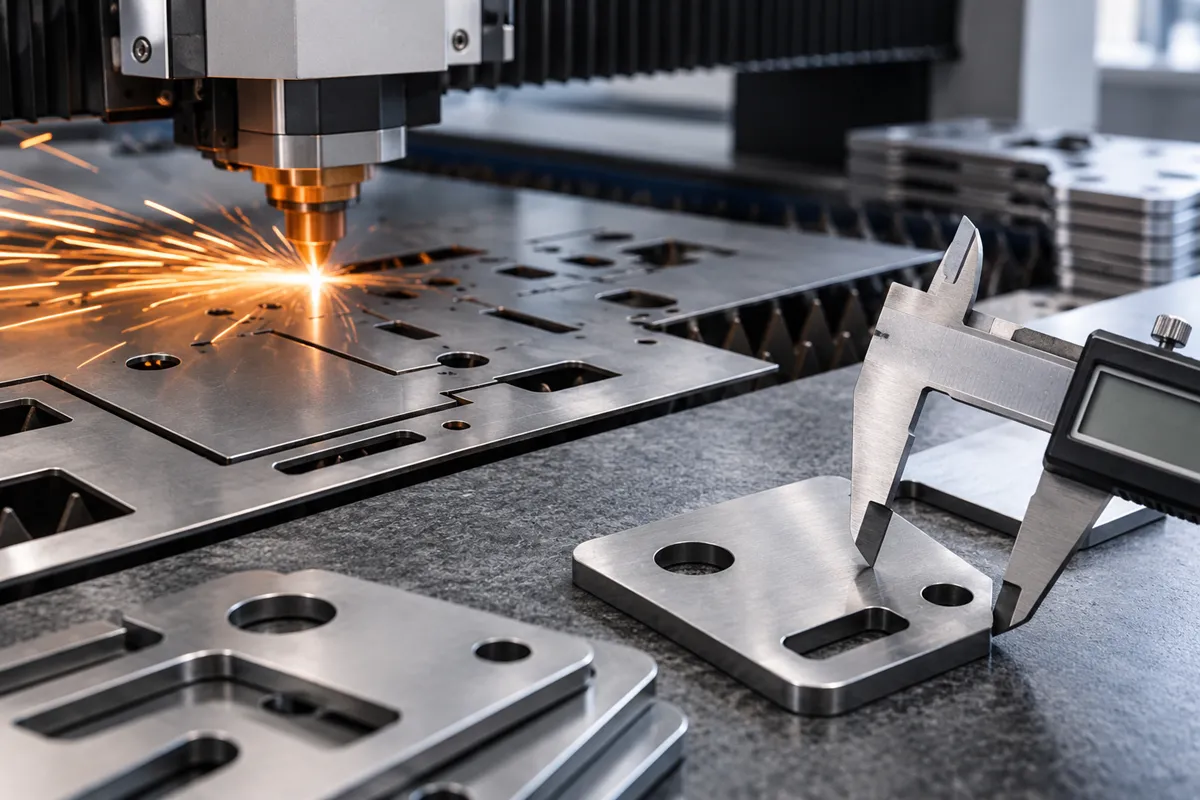
What Is Laser Cutting Tolerance?
Laser cutting tolerance is the permissible difference between the dimension specified on a drawing and the actual dimension of the finished part.
For example, if a drawing specifies:
100.00 ± 0.10 mm
the finished dimension should be between 99.90 mm and 100.10 mm.
It is important to distinguish between machine accuracy and finished-part tolerance. A laser machine may have very high positioning accuracy, but the final part can still be affected by material properties, heat, kerf width, and cutting conditions.
What Tolerance Can Laser Cutting Achieve?
There is no single tolerance that applies to every laser-cut component.
Depending on the material, thickness, geometry, machine, and process conditions, tolerances around ±0.10 mm to ±0.20 mm may be achievable for suitable applications. Tighter tolerances may require controlled processing, inspection, or secondary machining.
For this reason, instead of asking only for the machine’s stated accuracy, engineers should ask:
What tolerance can you consistently achieve on my material, thickness, and part geometry?
Factors That Affect Laser Cutting Tolerance
Material and Thickness
Material thickness has a significant effect on cutting accuracy.
Thin sheet generally allows tighter control, while thicker materials can be more sensitive to heat, beam characteristics, cutting speed, and assist-gas pressure.
Different materials also behave differently during cutting. Mild steel, stainless steel, aluminium, and other alloys may require different cutting parameters.
Always specify the material grade and thickness on the drawing or RFQ.
Laser Kerf
The laser removes a small amount of material as it cuts. This removed width is known as the kerf.
Kerf width can vary with material, thickness, laser power, focus, cutting speed, and gas pressure.
This is particularly important for:
- Holes
- Slots
- Tabs
- Interlocking parts
- Mating components
If two laser-cut parts need to fit together, the kerf and expected dimensional variation should be considered during design.
Thermal Effects
Laser cutting uses concentrated heat, and although the heat-affected area is relatively small, thermal movement can still influence dimensions.
This becomes more noticeable with:
- Large components
- Thin sheets
- Long narrow parts
- Dense patterns
- Closely spaced features
The cutting sequence and nesting strategy can also influence the final dimensions.
Part Geometry
The geometry of the part affects achievable tolerance.
Simple profiles are generally easier to produce consistently than parts containing very small holes, narrow slots, sharp internal corners, or long thin sections.
For example, a small hole in a thick plate may not be suitable for laser cutting, even if the machine itself has excellent positioning accuracy.
The relationship between feature size and material thickness should always be considered.
Machine and Process Condition
Laser cutting accuracy depends on more than the laser source.
Machine calibration, beam quality, cutting head condition, nozzle condition, focus, gas pressure, cutting speed, and maintenance all influence the finished component.
For production work, process consistency is just as important as the machine’s nominal accuracy.
Laser Cutting Tolerance vs CNC Machining Tolerance
Laser cutting is ideal for producing near-net-shape components, but it should not automatically be used where machining-level tolerances are required.
If a component needs a precision bearing bore, tight mating surface, or very close dimensional tolerance, a better process may be:
Laser cutting → CNC machining
The laser can produce the overall profile quickly, while machining can be used for the critical dimensions.
This approach can provide the required accuracy without machining the entire component, reducing manufacturing cost and production time.
How Should Engineers Specify Tolerances?
Avoid applying extremely tight tolerances to every dimension.
Identify the dimensions that are functionally important, such as:
- Assembly dimensions
- Hole locations
- Mating features
- Alignment features
- Bearing fits
- Sealing surfaces
Use tighter tolerances where necessary and practical tolerances for non-critical dimensions.
Overly tight tolerances can increase production cost without improving the function of the component.
What to Include When Requesting a Laser Cutting Quote
To receive an accurate quotation and manufacturing assessment, provide:
- Material grade
- Material thickness
- Quantity
- CAD file or DXF
- Engineering drawing
- Required tolerances
- Critical dimensions
- Surface-finish requirements, if applicable
- Any secondary operations such as bending, tapping, or machining
If a particular dimension is critical to assembly, clearly identify it on the drawing.
Choosing a Laser Cutting Service
For engineering components, don’t select a supplier based only on price.
Ask whether the supplier can consistently achieve the required tolerance for your specific material, thickness, and geometry.
A capable laser cutting service should be able to review your drawing, identify manufacturing concerns, recommend practical tolerances, and produce repeatable parts.
If you have a laser-cutting requirement, send us your drawing with the material, thickness, quantity, and required tolerance. Our team can review the component and provide a quotation based on your actual manufacturing requirements.
Need laser-cut parts? Send us your CAD drawing for a quotation.