
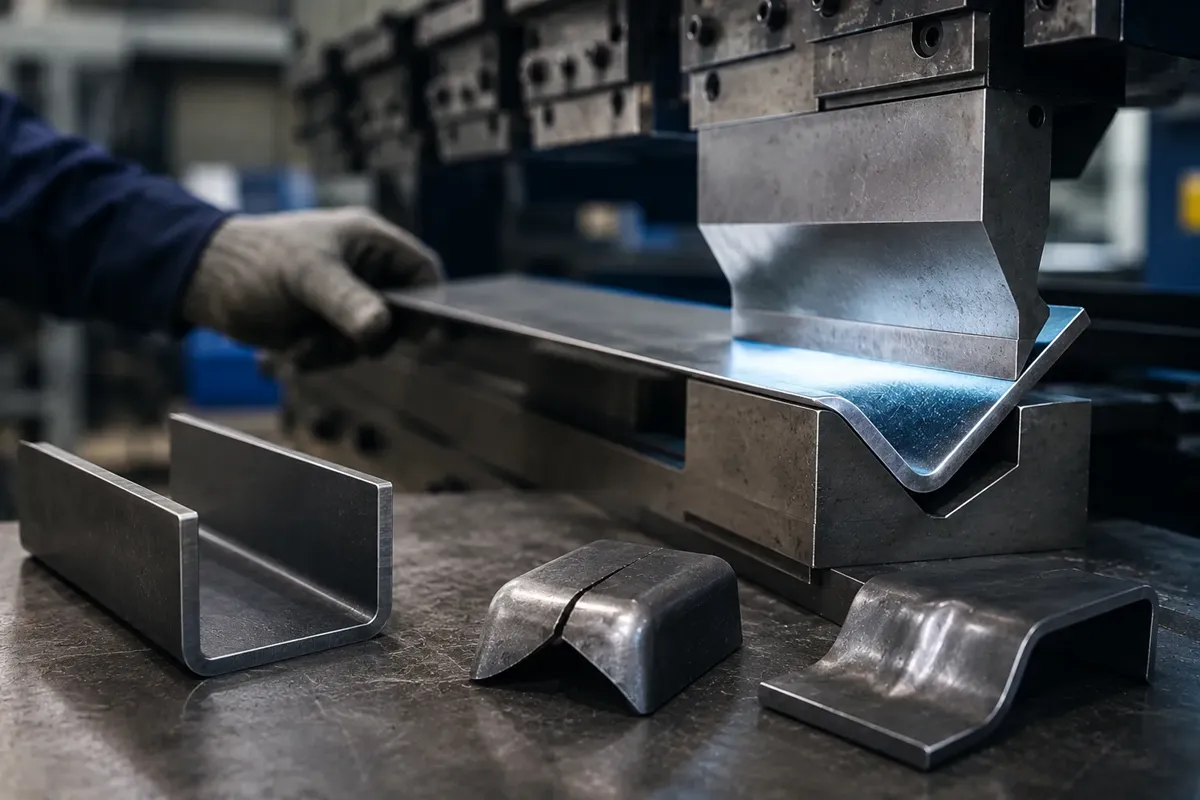
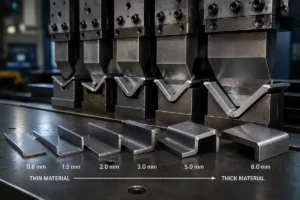
Material thickness is one of the most important factors in sheet metal bending. Even when the same machine, tooling, and bending method are used, variations in thickness can significantly impact bend angles, dimensional accuracy, springback, and overall part quality.
Understanding how material thickness influences the bending process helps manufacturers achieve more consistent results, reduce production errors, and improve product quality.
Why Material Thickness Matters
During bending, the metal undergoes both compression and stretching. The inside surface of the bend compresses while the outside surface stretches. The amount of force required and the way the material behaves during this process are directly affected by its thickness.
As material thickness changes, so do the bending characteristics, making accurate thickness control essential for precision fabrication.
Thicker Materials Require More Bending Force
One of the most noticeable effects of increased material thickness is the higher amount of force needed to create a bend.
Thicker sheets offer greater resistance to deformation, meaning the press brake must apply more tonnage to achieve the desired angle.
If insufficient force is applied, the material may not reach the required bend angle, leading to dimensional inaccuracies.
Proper tonnage calculations become increasingly important as material thickness increases.
Thickness Influences Bend Radius
Material thickness and bend radius are closely connected.
As thickness increases, larger bend radii are often required to prevent excessive stress concentration within the material. Attempting to create tight bends in thick materials can result in cracking, distortion, or premature material failure.
Selecting an appropriate bend radius helps maintain structural integrity and improves bending consistency.
Springback Changes with Thickness
Springback occurs when metal partially returns toward its original shape after bending pressure is released.
Material thickness affects how much springback occurs during the process. While thicker materials may appear more rigid, they can still experience springback depending on material type, bend radius, and forming method.
Failure to account for springback can lead to incorrect bend angles and parts that do not meet design specifications.
Manufacturers often compensate through overbending or specialized tooling adjustments.
Thickness Variations Can Reduce Accuracy
Even when materials are ordered to a specific thickness, small variations can occur between batches or suppliers.
A difference of just a fraction of a millimeter may affect:
Bend angle accuracy
Flange dimensions
Springback behavior
Required bending force
Part consistency
These variations become more significant in high-precision applications where tight tolerances are required.
Impact on Bend Allowance and Bend Deduction
Material thickness plays a critical role in flat pattern calculations.
Both bend allowance and bend deduction formulas use material thickness as a key variable. If the actual thickness differs from the design assumptions, the finished part dimensions may be inaccurate.
Accurate thickness measurements help ensure reliable flat pattern development and successful production outcomes.
Tool Selection Depends on Material Thickness
Choosing the correct punch and die is essential for achieving accurate bends.
Tooling designed for thin sheet metal may not perform correctly when used on thicker materials. Likewise, tooling intended for heavy-gauge material may damage thinner sheets or create poor-quality bends.
Matching tooling to material thickness improves:
Bend consistency
Surface finish
Dimensional accuracy
Tool life
Production efficiency
Thicker Materials Increase the Risk of Cracking
As thickness increases, greater force is required to deform the material. If an excessively small bend radius is used, stress concentrations can become severe enough to cause cracking.
This risk is especially common in high-strength materials such as stainless steel and advanced alloys.
Using appropriate bend radii and proper tooling helps reduce the likelihood of material failure.
Thin Materials Present Different Challenges
While thick materials require more force, thin materials introduce their own set of challenges.
Thin sheets are more susceptible to:
Distortion
Wrinkling
Surface marking
Handling damage
Dimensional variation
Proper support and careful machine setup are essential when working with thinner materials.
Maintaining Consistent Thickness Improves Quality
Manufacturers that maintain strict control over material thickness often achieve better bending accuracy and production consistency.
Quality control procedures may include:
Incoming material inspections
Thickness verification before production
Supplier quality monitoring
Regular machine calibration
These practices help reduce variability and improve final part quality.
Best Practices for Bending Different Material Thicknesses
Always verify actual material thickness before production.
Use tooling designed for the material gauge being processed.
Adjust tonnage calculations according to thickness.
Consider springback compensation during setup.
Use appropriate bend radii to prevent cracking.
Perform first-piece inspections before full production runs.
Maintain consistent material sourcing whenever possible.
Following these practices helps improve bending performance across a wide range of materials and applications.
Conclusion
Material thickness has a direct impact on bending force, springback, bend radius selection, tooling requirements, and overall part accuracy. Even minor variations in thickness can influence the final dimensions and quality of a bent component.
By understanding how thickness affects the bending process and applying proper fabrication techniques, manufacturers can improve consistency, reduce defects, and achieve more accurate results. If you need professional sheet metal bending services or have questions about material selection, bend calculations, or fabrication requirements, contact us today. Our team is ready to help you find the right solution for your project.