
Accurate sheet metal fabrication depends on more than just selecting the right material and tooling. Before a part is bent, manufacturers must determine the correct flat pattern dimensions to ensure the finished component meets design specifications. Two important concepts used in this process are bend allowance and bend deduction.
Although these terms are closely related, they serve different purposes in sheet metal design and fabrication. Understanding how bend allowance and bend deduction work can help reduce errors, improve accuracy, and minimize material waste.
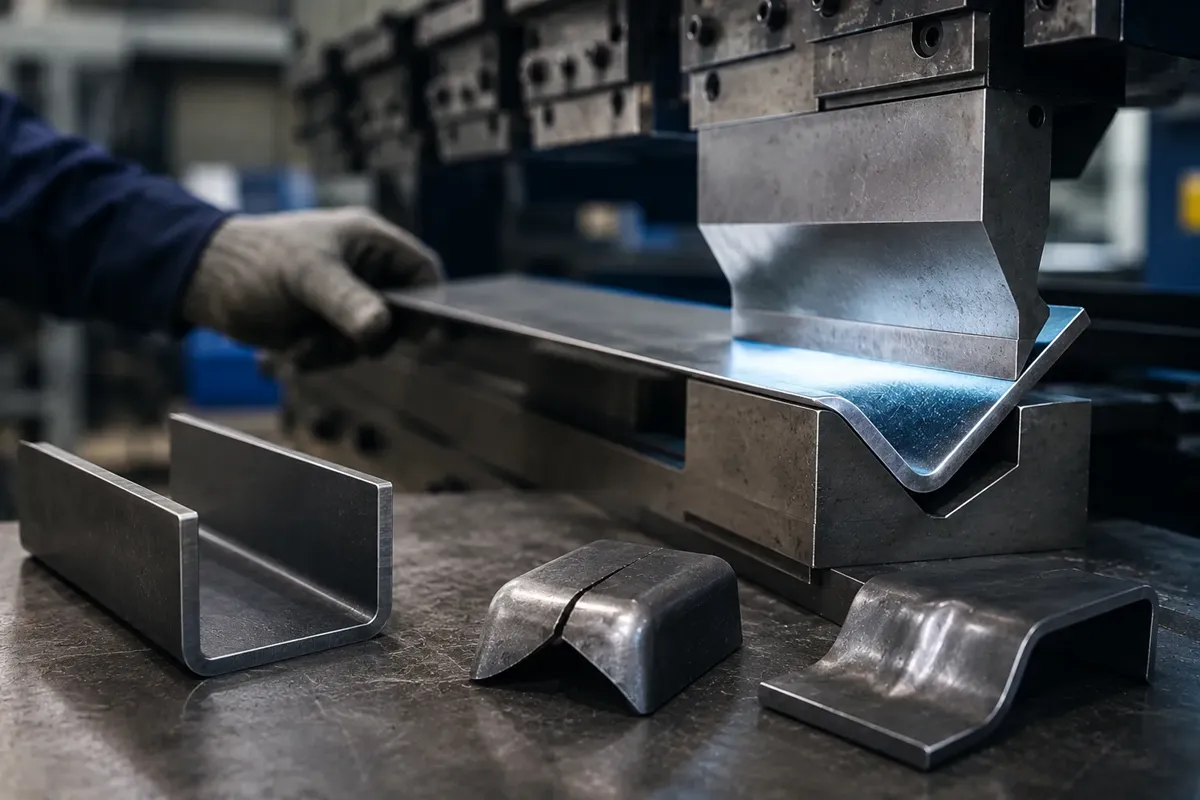
Why Bend Calculations Matter
When sheet metal is bent, the material does not simply fold at a single line. The inside of the bend compresses while the outside stretches. Because of this material movement, the final dimensions of a bent part differ from the dimensions of the original flat sheet.
Without proper calculations, finished parts may be too long, too short, or fail to fit correctly during assembly.
Bend allowance and bend deduction help fabricators determine the correct flat blank size before bending begins.
What Is Bend Allowance?
Bend allowance is the amount of material required to create a bend. It represents the length of the material that forms the curved section of the bend and is added to flat pattern calculations.
In simple terms, bend allowance accounts for the material that stretches and flows around the bend radius during the bending process.
Manufacturers use bend allowance to determine how much material is needed before bending so the final dimensions remain accurate.
Factors That Affect Bend Allowance
Several variables influence bend allowance calculations:
Material thickness
Inside bend radius
Bend angle
Material type
K-factor value
Any change in these factors can affect the final bend allowance value.
What Is Bend Deduction?
Bend deduction is the amount that must be subtracted from the total flange lengths to determine the correct flat pattern size.
Unlike bend allowance, which adds material length to calculations, bend deduction removes material length from the overall dimensions.
Fabricators commonly use bend deduction when converting finished part dimensions into flat blank dimensions.
The purpose is to compensate for the material that effectively shifts during the bending process.
The Difference Between Bend Allowance and Bend Deduction
Although both calculations are used to determine flat pattern dimensions, they approach the problem differently.
Bend allowance calculates the length of material consumed within the bend itself.
Bend deduction calculates the amount that must be removed from the sum of the finished flange dimensions.
Both methods ultimately help achieve the same goal: producing an accurate flat blank for fabrication.
Understanding Material Behavior During Bending
When a metal sheet is bent, three zones are created within the material.
The inside surface experiences compression.
The outside surface experiences tension and stretching.
Between these two regions is the neutral axis.
The neutral axis is important because it neither stretches nor compresses during bending. Bend allowance calculations are based on the length of this neutral axis as it passes through the bend.
Its position is determined using the K-factor.
What Is the K-Factor?
The K-factor is a ratio that identifies the location of the neutral axis within the material thickness.
It helps determine how much material stretches during bending and plays a major role in bend allowance calculations.
Different materials and bending methods may produce different K-factor values.
Accurate K-factor selection improves flat pattern accuracy and reduces dimensional errors.
Why Accurate Bend Calculations Are Important
Incorrect bend allowance or bend deduction values can create several manufacturing problems.
Parts may not fit together properly.
Assembly issues can occur.
Material waste increases.
Production costs rise.
Additional rework may be required.
Accurate calculations help ensure consistency across prototypes, small production runs, and high-volume manufacturing.
Common Mistakes in Bend Calculations
Many fabrication errors can be traced to incorrect bend data.
One common mistake is assuming all materials behave the same way. Different metals have different stretching characteristics and springback behavior.
Another mistake is using generic bend tables without verifying material thickness and tooling conditions.
Ignoring actual machine setup conditions can also result in inaccurate flat patterns.
How Manufacturers Improve Accuracy
Modern fabrication facilities often use CAD and CAM software to automate bend calculations.
These systems allow engineers to input material properties, bend radii, and tooling information to generate accurate flat patterns.
Many companies also perform test bends and maintain internal bend tables based on real production data.
Combining software calculations with practical testing provides the highest level of accuracy.
Bend Allowance vs Bend Deduction: Which Should You Use?
Both methods are widely accepted in sheet metal fabrication.
Engineers often work with bend allowance when developing flat patterns and design calculations.
Fabricators frequently use bend deduction when converting finished dimensions into production-ready blanks.
The choice often depends on company standards, software systems, and manufacturing workflows.
Regardless of the method used, consistency is essential throughout the design and production process.
Best Practices for Accurate Bending Calculations
Use verified material specifications.
Maintain consistent tooling setups.
Account for material thickness variations.
Use appropriate bend radii.
Validate calculations with test parts.
Maintain updated bend charts.
Monitor production results and adjust values when necessary.
These practices help improve dimensional accuracy and reduce production errors.
Conclusion
Understanding bend allowance and bend deduction is essential for producing accurate sheet metal components. These calculations help ensure proper flat pattern development, reduce material waste, improve assembly fit, and maintain consistency throughout the manufacturing process. By applying the correct bending calculations and considering factors such as material thickness, bend radius, and tooling conditions, manufacturers can achieve higher-quality results and more efficient production.
If you need professional sheet metal bending services or have questions about bend allowance, bend deduction, or custom fabrication requirements, our team is here to help. Contact us today to discuss your project, request a quote, or get expert guidance for your sheet metal manufacturing needs.