
Sheet metal bending is one of the most widely used fabrication processes in modern manufacturing. It transforms flat metal sheets into functional components by applying force to create a permanent angle or shape without removing material. From automotive panels and industrial enclosures to HVAC systems and consumer products, bending plays a critical role in producing strong, accurate, and cost-effective metal parts.
Understanding the fundamentals of sheet metal bending helps manufacturers improve part quality, reduce production errors, and optimize fabrication costs.
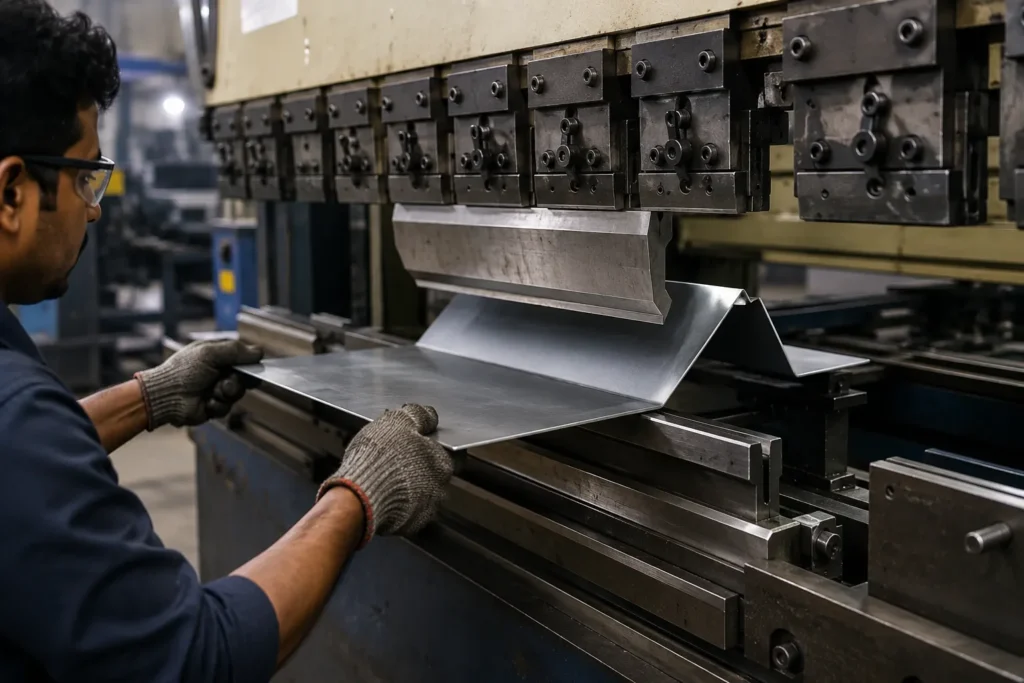
What Is Sheet Metal Bending?
Sheet metal bending is a forming process in which a flat metal sheet is deformed along a straight axis to create an angle, flange, channel, or custom profile. The process uses specialized tools and equipment to apply force beyond the material’s yield strength, causing permanent deformation while maintaining structural integrity.
Unlike machining operations that remove material, bending reshapes the metal while preserving its thickness and overall material volume.
How Sheet Metal Bending Works
During bending, a sheet metal blank is positioned between a punch and a die. The punch applies force to the material, pushing it into the die opening and creating the desired bend angle.
The amount of force required depends on several factors, including:
- Material type
- Material thickness
- Bend angle
- Bend length
- Die opening size
- Material strength
Proper control of these variables ensures accurate and repeatable bending results.
Common Sheet Metal Bending Methods
Air Bending
Air bending is the most commonly used bending technique. The punch presses the material into the die without forcing it completely to the bottom.
Advantages include:
- Lower bending force requirements
- Flexible angle production
- Reduced tool wear
- Faster setup adjustments
Because the material only contacts specific points of the tooling, various bend angles can be produced using the same die.
Bottom Bending
Bottom bending forces the sheet metal into the bottom of the die cavity.
Benefits include:
- Higher accuracy
- Better angle consistency
- Reduced springback
However, this method requires greater force and often dedicated tooling for different bend angles.
Coining
Coining applies very high pressure to compress the material directly into the die shape.
Advantages include:
- Extremely precise angles
- Minimal springback
- Excellent repeatability
Coining is often used for applications requiring tight tolerances and consistent production quality.
Types of Bends in Sheet Metal Fabrication
V-Bend
The most common bending method, producing a simple angular bend using a V-shaped die.
U-Bend
Creates a U-shaped profile commonly used in brackets, channels, and support structures.
Offset Bend
Produces two opposite bends close together, creating a stepped feature in the sheet metal.
Hem Bend
Folds the edge of a sheet onto itself to eliminate sharp edges and increase strength.
Roll Bend
Uses rollers to create large-radius curves and cylindrical shapes.
Important Bending Terminology
Bend Angle
The angle formed between two surfaces after bending.
Bend Radius
The inside radius created at the bend area. Larger radii reduce material stress and cracking risk.
Neutral Axis
The area within the material thickness that experiences neither compression nor stretching during bending.
Bend Allowance
The amount of material required to accommodate the bend while maintaining accurate flat pattern dimensions.
Bend Deduction
A calculation used to determine the final flat length before bending.
Springback
The tendency of metal to partially return toward its original shape after bending pressure is released.
Understanding these terms is essential for accurate part design and manufacturing.
Materials Commonly Used for Sheet Metal Bending
Different materials respond differently during the bending process.
Mild Steel
- Strong and durable
- Cost-effective
- Good formability
- Widely used in industrial applications
Stainless Steel
- Excellent corrosion resistance
- Higher strength
- Requires greater bending force
- Common in food processing and medical industries
Aluminum
- Lightweight
- Corrosion resistant
- Easy to bend
- Popular in aerospace and electronics applications
Copper
- Highly ductile
- Excellent electrical conductivity
- Suitable for complex bends
Brass
- Attractive appearance
- Good corrosion resistance
- Common in decorative and architectural applications
Factors Affecting Bending Quality
Material Thickness
Thicker materials require greater force and larger bend radii.
Grain Direction
Bending across the grain generally reduces the risk of cracking compared to bending parallel to the grain.
Bend Radius
Using a radius that is too small may cause material cracking or distortion.
Tool Selection
Proper punch and die combinations improve bend accuracy and surface quality.
Material Properties
Yield strength, hardness, and ductility directly influence bending performance.
Common Sheet Metal Bending Defects
Springback
The most common bending challenge, causing angles to open slightly after forming.
Cracking
Occurs when excessive stress is concentrated in the bend area.
Wrinkling
Results from compressive forces causing the material to buckle.
Distortion
Can occur when improper tooling or excessive force is used.
Surface Marks
Tool pressure may leave visible marks on the material surface.
Proper tooling selection and process control help minimize these issues.
Advantages of Sheet Metal Bending
Sheet metal bending offers several manufacturing benefits:
- Cost-effective production
- High repeatability
- Minimal material waste
- Strong finished components
- Fast production cycles
- Suitable for both prototypes and mass production
- Compatible with automated manufacturing systems
These advantages make bending one of the most efficient metal fabrication processes available.
Applications of Sheet Metal Bending
Sheet metal bending is used across numerous industries, including:
- Automotive components
- Aerospace structures
- Electrical enclosures
- HVAC ductwork
- Industrial machinery
- Construction materials
- Consumer electronics
- Furniture manufacturing
The versatility of bending allows manufacturers to produce a wide range of products with varying shapes and sizes.
Best Practices for Successful Sheet Metal Bending
To achieve consistent and accurate results:
- Use appropriate bend radii for the material
- Account for springback during design
- Select proper tooling for each application
- Maintain accurate bend allowance calculations
- Consider grain direction during part layout
- Verify material properties before production
- Perform prototype testing when necessary
Following these practices can significantly improve product quality and reduce manufacturing errors.
Conclusion
Sheet metal bending is a fundamental fabrication process that converts flat metal sheets into functional components for countless industries. Whether producing simple brackets or complex industrial assemblies, understanding bending methods, material behavior, tooling requirements, and design considerations is essential for achieving high-quality results.
By applying proper bending techniques and design principles, manufacturers can improve efficiency, reduce waste, and produce durable components that meet demanding performance requirements.