
When designing parts for laser cutting, accuracy is often one of the most important requirements. Whether you’re producing brackets, enclosures, machine components, or custom fabrication parts, understanding laser cutting tolerances helps ensure your finished products fit and function as intended.
In this guide, we’ll explain what laser cutting tolerances are, what affects them, and how manufacturers can achieve the best results.
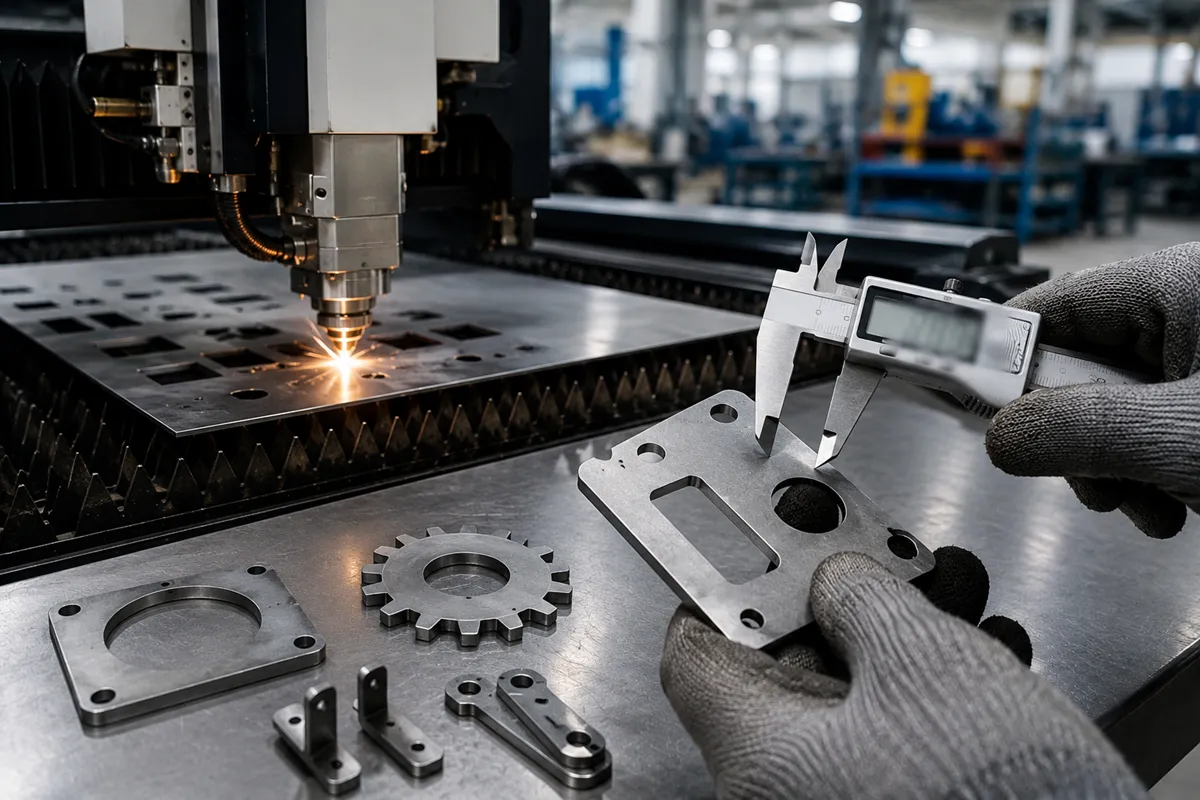
What Is a Laser Cutting Tolerance?
A tolerance is the acceptable variation between the designed dimension and the final manufactured dimension.
For example, if a part dimension is specified as 100 mm with a tolerance of ±0.1 mm, the finished part can measure anywhere between 99.9 mm and 100.1 mm while still meeting specifications.
Laser cutting is known for its excellent accuracy compared to many traditional cutting methods, making it a preferred choice for precision metal fabrication.
Typical Laser Cutting Tolerances
Actual tolerances depend on material type, thickness, part geometry, and machine capability.
In general:
- Thin sheet metals achieve tighter tolerances.
- Thicker materials may have slightly larger variations.
- Simple geometries are usually more accurate than highly intricate designs.
For critical applications, tolerance requirements should always be discussed during the quotation stage.
Factors That Affect Laser Cutting Accuracy
1. Material Thickness
As material thickness increases, maintaining extremely tight tolerances becomes more challenging.
Thicker materials require more laser energy and may experience slight variations along the cut edge compared to thinner sheets.
2. Material Type
Different metals react differently during the cutting process.
Common materials include:
- Mild Steel
- Stainless Steel
- Aluminum
- Brass
- Copper
Each material has unique cutting characteristics that can influence dimensional accuracy.
3. Part Geometry
Complex designs with:
- Small holes
- Narrow slots
- Sharp corners
- Intricate patterns
can be more difficult to maintain within extremely tight tolerances compared to simpler profiles.
4. Heat Effects
Although laser cutting produces a relatively small heat-affected zone, thermal expansion and contraction can still influence final dimensions, particularly on larger parts.
5. Machine Quality and Calibration
Modern fiber laser cutting systems provide exceptional positioning accuracy and repeatability.
Regular machine maintenance and calibration are essential for consistently achieving precise results.
Hole Size and Feature Considerations
One common mistake is designing holes or slots that are too small for the material thickness.
As a practical guideline:
- Hole diameters should be appropriate for the material thickness.
- Very small features may require design adjustments.
- Tight internal corners may need radius considerations.
Proper design practices improve both accuracy and manufacturability.
Designing for Better Accuracy
To achieve the best results:
Use Realistic Tolerances
Specifying unnecessarily tight tolerances can increase manufacturing complexity and cost.
Only apply critical tolerances where they are truly required.
Keep Geometry Clean
Well-prepared CAD files help ensure accurate programming and cutting.
Before submitting designs:
- Remove duplicate entities
- Close all profiles
- Verify dimensions
- Eliminate unnecessary layers
Consider Secondary Operations
If parts require bending, machining, welding, or assembly, tolerance requirements should account for the complete manufacturing process rather than laser cutting alone.
Why Tolerances Matter
Proper tolerance management helps:
- Improve assembly fit
- Reduce rework
- Minimize production delays
- Improve product quality
- Lower manufacturing costs
Understanding realistic manufacturing capabilities allows projects to move from design to production more efficiently.
How We Maintain High Accuracy
Our advanced fiber laser cutting systems are designed to deliver consistent precision across a wide range of materials and thicknesses.
By combining modern equipment, optimized cutting parameters, experienced programming, and strict quality control procedures, we help customers achieve reliable dimensional accuracy for both prototype and production requirements.
Need Help With Your Design?
If your project includes critical dimensions or tight tolerances, our team can review your CAD files and recommend the most practical manufacturing approach.
Contact us today to discuss your laser cutting requirements and ensure your parts are produced accurately, efficiently, and cost-effectively.