
When designing a laser-cut component, slot width is an important consideration.
A slot may look simple in a CAD drawing, but making it too narrow for the material thickness can lead to poor edge quality, dimensional variation, excessive heat, or difficulty removing molten material.
So, how narrow can a laser-cut slot actually be?
The answer depends on the material, thickness, laser machine, cutting parameters, slot length, and required tolerance.
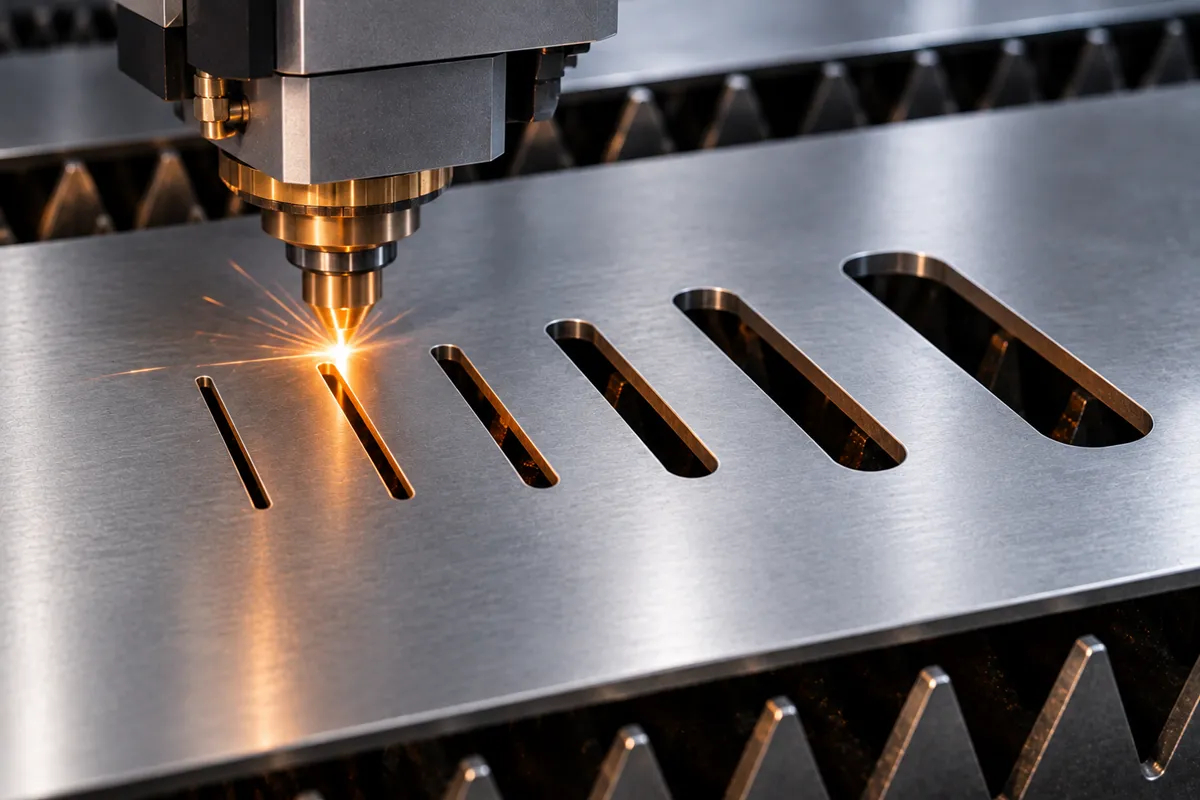
What Is the Minimum Slot Width for Laser Cutting?
There is no single minimum slot width that applies to every laser-cutting job.
As a practical starting point, engineers commonly design slots with a width equal to or greater than the material thickness for general laser-cutting applications.
Practical Slot Width Guide
| Material Thickness | Recommended Starting Slot Width | Suitable For |
|---|---|---|
| 0.8 mm | 0.8–1.0 mm | Small openings and light sheet components |
| 1.0 mm | 1.0–1.2 mm | General sheet-metal parts |
| 1.5 mm | 1.5–1.8 mm | Brackets, panels and fabricated parts |
| 2.0 mm | 2.0–2.5 mm | General industrial components |
| 3.0 mm | 3.0–3.5 mm | Machine parts and fabrication components |
| 4.0 mm | 4.0–5.0 mm | Structural and industrial components |
| 5.0 mm | 5.0–6.0 mm | Plate components |
| 6.0 mm | 6.0–7.0 mm | Heavy-duty fabricated parts |
| 8.0 mm | 8.0–10.0 mm | Thick plate applications |
| 10.0 mm | 10.0 mm+ | Heavy plate; supplier review recommended |
These values are practical design guidelines, not guaranteed machine limits. The actual minimum slot width depends on the material grade, thickness, laser system, cutting parameters, slot length, and required dimensional tolerance.
For a production component with a critical narrow slot, the supplier should confirm the feature before manufacturing.
Why Does Material Thickness Affect Slot Width?
A laser must melt and remove material throughout the entire thickness of the sheet.
As thickness increases, controlling a very narrow cut becomes more difficult.
Material thickness can affect:
- Heat accumulation
- Cutting speed
- Kerf
- Edge quality
- Dross
- Slot dimensional accuracy
- Slot geometry
A narrow slot that cuts cleanly in a thin sheet may not produce the same result in a thicker plate.
This is why slot width should always be considered together with material thickness.
Laser Kerf and Slot Width
The kerf is the width of material removed by the laser during cutting.
The actual kerf depends on factors such as:
- Material
- Thickness
- Laser power
- Cutting speed
- Focus position
- Assist gas
- Nozzle condition
- Machine settings
When a slot becomes very narrow, the kerf becomes increasingly important because there is less space for the laser to complete the cutting path and for molten material to escape.
A slot that is technically possible to cut may therefore still be unsuitable if a specific width or fit is required.
What Happens If a Slot Is Too Narrow?
If a slot is designed below the practical capability of the process, several problems can occur.
Poor Edge Quality
The edges may become rougher or show increased dross.
Heat Build-Up
A narrow feature can concentrate heat in a small area, potentially causing dimensional variation or distortion.
Dimensional Variation
The finished slot may not consistently match the CAD dimension, particularly when tight tolerances are required.
Poor Slot Geometry
Very narrow slots can lose their intended shape, especially in thicker materials.
Difficulty Removing Material
Molten material may not evacuate efficiently from a narrow feature, affecting the finished cut.
For production components, these issues can affect assembly and repeatability.
Does Slot Length Matter?
Yes.
Slot width is not the only consideration. The length-to-width ratio can also influence manufacturability.
A short, wide slot is generally easier to produce than a very long and narrow slot.
Long narrow slots can be more sensitive to:
- Heat accumulation
- Material movement
- Cutting sequence
- Part stability
- Dimensional variation
If a slot is particularly long and narrow, it is worth discussing the design with your laser cutting supplier before production.
Does the Material Type Matter?
Yes.
Different materials respond differently to laser cutting.
Common materials such as:
- Mild steel
- Stainless steel
- Aluminium
can all be laser cut, but their cutting parameters are different.
Reflective materials and specialized alloys may require additional consideration.
The same slot width should therefore not automatically be assumed to have the same cutting performance across different materials.
Minimum Slot Width vs Slot Tolerance
These are two different requirements.
Minimum slot width asks:
Can the laser physically produce this feature?
Slot tolerance asks:
How accurately can the finished slot match the specified dimension?
For example, a supplier may be able to cut a 2 mm slot, but that does not automatically mean the slot can be manufactured to 2.00 ± 0.02 mm consistently.
If the slot is used for a precision fit, the required tolerance should be clearly specified on the engineering drawing.
When Should You Use CNC Machining Instead?
Laser cutting is excellent for producing profiles, openings, slots, brackets, panels, and fabricated components.
However, if a slot requires very tight dimensional control, a secondary machining operation may be more appropriate.
A practical manufacturing approach can be:
Laser cutting → CNC machining
The laser produces the overall component quickly, while machining is used only for critical features.
This can provide better precision without machining the entire part.
How Engineers Should Design Slots for Laser Cutting
Before finalizing your CAD model, consider these points:
1. Match slot width to material thickness
Avoid designing extremely narrow slots without confirming manufacturability.
2. Consider the slot length
Long, narrow slots may require additional process consideration.
3. Specify realistic tolerances
Use tight tolerances only where the function of the component requires them.
4. Consider the slot’s purpose
A ventilation opening, weight-reduction slot, cable passage, and precision assembly feature have different requirements.
5. Consider the distance between features
Closely spaced slots and holes can increase localized heat and affect the surrounding material.
6. Discuss critical features before production
A supplier can often identify potential manufacturing problems before the parts are cut.
What Information Should You Provide for a Laser Cutting Quote?
For an accurate quotation and manufacturing review, provide:
- Material grade
- Material thickness
- Quantity
- CAD file or DXF
- Engineering drawing
- Slot dimensions
- Required tolerances
- Critical dimensions
- Secondary operations, if required
If a particular slot is important for assembly, clearly identify it on the drawing.
Need Laser Cutting for Narrow or Precision Slots?
The minimum practical slot width depends on the material, thickness, geometry, machine capability, and required tolerance.
Instead of designing to a generic minimum value, have the feature checked against the actual laser cutting process before production.
If you have a component with narrow slots, complex profiles, or tight dimensional requirements, send us your CAD drawing along with the material, thickness, and quantity.
Our team can review the design, assess its laser-cutting feasibility, and provide a quotation based on your actual requirements.
Have a drawing ready? Send it to us for a laser cutting quotation.