
GI sheet is a galvanised steel sheet with a protective zinc coating. It is widely used where the strength of steel is required along with better resistance to corrosion.
Because of this combination, GI sheets are commonly found in HVAC systems, electrical panels, enclosures, construction, automotive components, solar equipment, and general fabrication.
Laser cutting is a practical option for GI sheet when accurate profiles, holes, slots, and customised shapes are required.
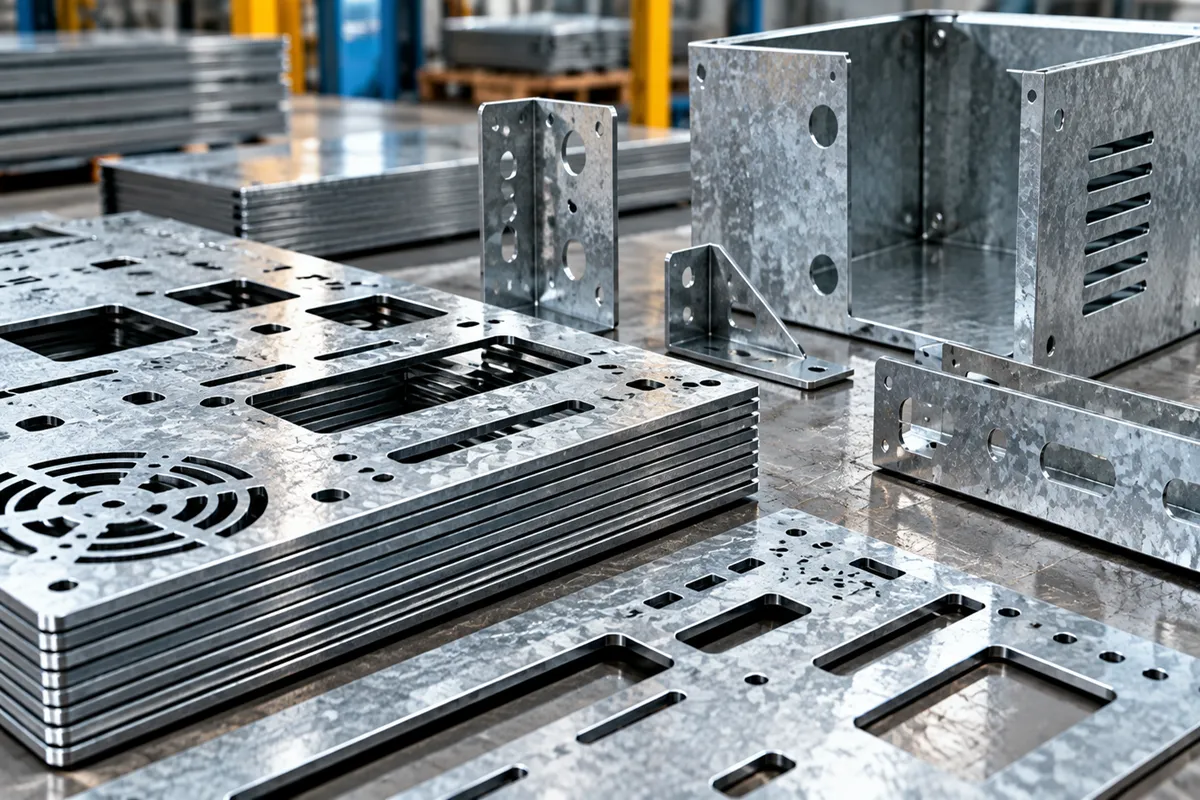
GI Sheet Laser Cutting Cost
The cost of cutting GI sheet mainly depends on the amount of material being used and the machine time required for the job.
A simple part with straight edges will generally cost less to process than a detailed component containing many holes, slots, and curves.
The major cost factors are:
- GI sheet thickness
- Sheet size and material cost
- Cutting length
- Component design
- Number of holes and cut-outs
- Quantity
- Sheet nesting and material utilisation
- Cutting time
- Assist gas consumption
For larger production quantities, efficient nesting can make a significant difference by reducing unused material.
For an accurate quotation, the drawing, GI thickness, quantity, and sheet requirement are generally sufficient to begin the costing process.
GI Sheet Laser Cutting Capacity
The practical thickness range depends on the laser machine, power, GI sheet grade, zinc coating, and the quality required from the finished component.
Thin GI sheets can be processed at high speeds and are particularly suitable for detailed sheet-metal components. Thicker sheets require slower cutting speeds and carefully selected process parameters.
Rather than looking only at the maximum thickness a laser can cut, production requirements should also consider cutting speed, edge quality, dimensional accuracy, and overall cost per component.
A Special Consideration When Cutting GI Sheet
The main difference between GI sheet and ordinary mild steel is the zinc coating.
During laser cutting, the heat affects the zinc layer around the cut area. This makes the choice of cutting parameters important for achieving a clean and consistent result.
Heating the zinc coating can also generate fumes, so proper fume extraction and ventilation are important during the cutting process.
Depending on the end use, the exposed cut edge may also need additional corrosion protection after cutting.
Applications of GI Sheet Laser Cutting
| Industry / Sector | Common Applications | Typical Components |
|---|---|---|
| HVAC | Air-conditioning and ventilation systems | Duct components, brackets, panels |
| Electrical | Panels and equipment protection | Enclosures, covers, mounting plates |
| Construction | Building and infrastructure | Brackets, panels, supports |
| Automotive | Vehicle and equipment components | Brackets, panels, supports |
| Engineering | General industrial components | Plates, brackets, covers |
| Industrial Equipment | Housings and fabricated assemblies | Panels, covers, mounting parts |
| Solar | Mounting and support systems | Brackets, plates, supports |
| Appliances | Sheet-metal components | Panels, covers, internal parts |
| Agricultural Equipment | Fabricated equipment parts | Covers, brackets, panels |
| General Fabrication | Custom sheet-metal products | Profiles, plates, enclosures |
Advantages of Laser Cutting GI Sheet
Laser cutting is useful for GI sheet when the component requires a combination of accuracy and design flexibility.
- Accurate cutting for detailed components
- Complex profiles can be produced directly from CAD drawings
- No dedicated die is required for many cutting jobs
- Good repeatability for batch production
- Efficient nesting can reduce material wastage
- Suitable for prototypes and production quantities
GI Sheet vs Mild Steel
Both materials are used extensively in fabrication, but their characteristics are different.
| Feature | GI Sheet | Mild Steel |
|---|---|---|
| Surface | Zinc-coated | Uncoated |
| Corrosion Resistance | Better due to zinc coating | Usually requires surface protection |
| Common Uses | HVAC, panels, enclosures, construction | Machinery, fabrication, structural components |
| Cutting Consideration | Zinc coating requires suitable process control | Generally simpler material processing |
| Cut Edge | Zinc coating is affected during cutting | Steel is exposed at the cut |
The choice between GI and mild steel depends on the application, particularly the required corrosion resistance, strength, environment, appearance, and finishing.
Conclusion
GI sheet laser cutting is widely used for producing accurate components in HVAC, electrical, construction, automotive, engineering, solar, and general fabrication.
The final cutting cost depends on the material, component design, quantity, and processing time, while the practical cutting capacity depends on the laser system and GI sheet thickness.
For a GI laser cutting requirement, providing the CAD drawing, sheet thickness, quantity, and application makes it easier to determine the appropriate process and cost.