
Before sending a laser cutting job, buyers should confirm whether the supplier can handle the required sheet size, material, and thickness. Machine capacity directly affects whether a part can be produced efficiently and accurately.
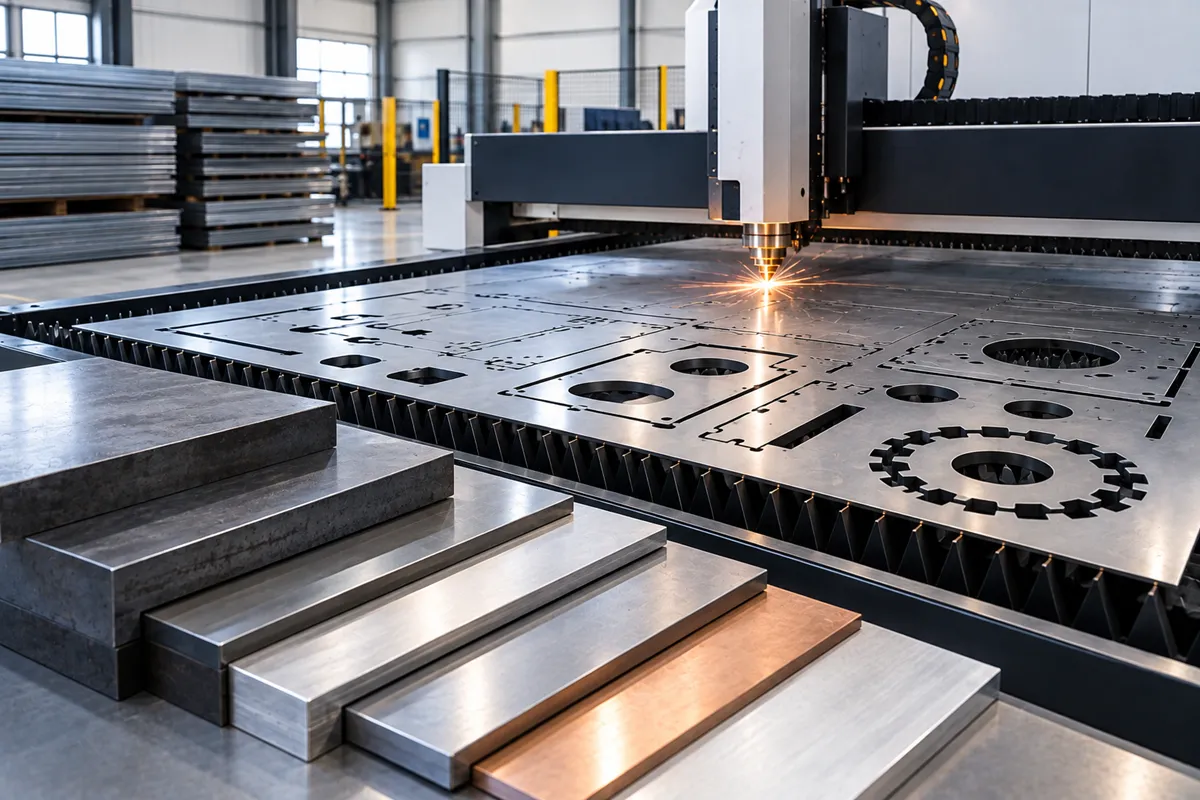
What Does Laser Cutting Capacity Mean?
Laser cutting capacity generally refers to:
- Maximum sheet size the machine can accommodate
- Maximum material thickness it can cut
- Material types and grades supported
- Maximum part size and cutting area
- Capability for holes, slots, and complex profiles
Capacity varies by machine type, laser power, material, and thickness.
Maximum Sheet Size
The maximum sheet size depends on the laser machine’s working bed. Common industrial machine sizes include approximately:
| Machine Bed Size | Typical Application |
|---|---|
| 1500 × 3000 mm | General sheet-metal parts |
| 2000 × 4000 mm | Larger industrial components |
| 2000 × 6000 mm | Long panels and fabricated parts |
| Custom / larger beds | Oversized components |
A larger machine bed can reduce the need to split large components and may improve material utilization.
Maximum Cutting Thickness
Maximum thickness is not the same for every material. A laser may cut a particular thickness of mild steel but have a lower practical limit for stainless steel or aluminium.
For example, cutting capability depends on:
Material + Grade + Thickness + Laser Power + Machine Condition + Cutting Parameters
Always confirm the supplier’s practical capability for your exact material and thickness rather than relying only on the machine’s advertised maximum.
What Buyers Should Confirm
Before requesting a quotation, provide:
| Requirement | Example |
|---|---|
| Material | Mild Steel |
| Grade | IS 2062 |
| Thickness | 6 mm |
| Sheet / Part Size | 1800 × 2800 mm |
| Quantity | 50 pcs |
| Critical Tolerance | ±0.10 mm |
| Additional Operations | Bending + Deburring |
This allows the supplier to check machine capacity, material availability, nesting, cutting parameters, and production time before quoting.
Does Maximum Capacity Mean Better Cutting?
Not necessarily. A machine may technically cut a thick plate but may not be the most suitable choice for every job. For production parts, buyers should also consider accuracy, edge quality, small-feature capability, repeatability, and lead time.
Key Takeaway
When choosing a laser cutting company, don’t ask only “What is your maximum thickness?” Ask whether the supplier can reliably process your specific material, thickness, sheet size, geometry, and tolerance.
Send your CAD/DXF file along with material, thickness, quantity, and part size to confirm laser cutting feasibility and get an accurate quotation.