
If you’ve ever ordered metal parts for a machine, panel, enclosure, or fabrication project, you’ve probably heard two common terms: laser cutting and plasma cutting.
Many customers ask us the same question:
“Which one should I choose?”
The answer depends on what you’re making.
A few years ago, most fabrication shops used plasma cutting for many jobs because it was fast and affordable. Today, laser cutting has become the preferred option for many industrial components because manufacturers want better accuracy, cleaner parts, and less rework.
Let’s look at why.
When Small Errors Become Big Problems
Imagine you’re assembling a machine and one bracket is off by just a few millimeters.
One hole doesn’t align.
The bolt doesn’t fit properly.
Now production stops while someone modifies the part.
What looked like a small cutting issue suddenly becomes lost time, extra labor, and frustration.
This is one of the main reasons companies choose laser cutting.
Laser-cut parts are much more accurate, which means they fit where they’re supposed to fit.
The Difference You Can See Immediately
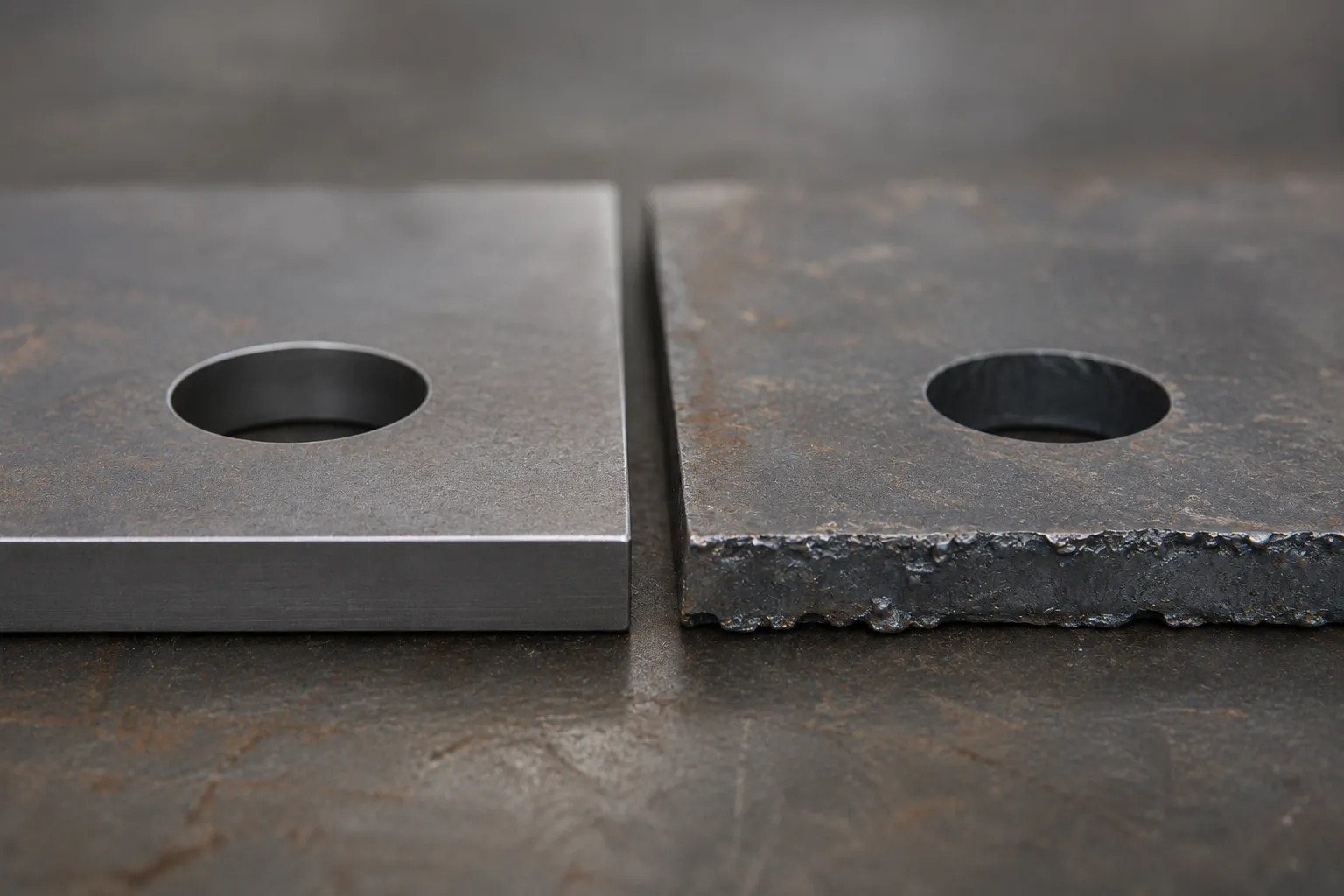
Place a laser-cut part and a plasma-cut part side by side.
Most people notice the difference right away.
Laser-cut edges look clean and smooth. The corners are sharp, and the overall finish feels professional.
Plasma-cut parts can still do the job, but the edges are usually rougher and may need additional grinding before they are ready for use.
If appearance matters—or if the part goes directly into assembly—laser cutting usually saves time.
Where Plasma Cutting Still Makes Sense
This doesn’t mean plasma cutting is bad.
In fact, for thick steel plates and heavy fabrication work, plasma cutting is often a practical choice.
If you’re building large structures, heavy frames, or construction equipment, plasma cutting can be a cost-effective solution.
Many fabrication shops continue to use it successfully for these types of projects.
The key is using the right process for the right job.
Why More Manufacturers Are Moving to Laser Cutting
Over the years, we’ve noticed a common trend.
Customers don’t just want parts cut.
They want parts that arrive ready to use.
They want:
- Better fitting components
- Consistent quality
- Less finishing work
- Faster assembly
- Fewer production delays
Laser cutting helps achieve all of these goals.
That’s why industries such as electrical panel manufacturing, machinery production, automotive components, and precision fabrication rely heavily on laser-cut parts.
So Which One Should You Choose?
If your project involves precision components, sheet metal parts, control panels, machine brackets, or products that need a clean finish, laser cutting is usually the better option.
If you’re working with very thick metal and large structural fabrication where appearance and tight tolerances are less important, plasma cutting can still be a good choice.
At the end of the day, the cheapest cut is not always the most economical one.
A part that fits perfectly the first time often saves more money than a part that needs fixing later.
Need Help Choosing the Right Process?
Every project is different.
If you’re unsure whether laser cutting or plasma cutting is best for your component, our team can review your drawings and suggest the most practical solution.
We provide laser cutting, CNC bending, and machining services for a wide range of industrial applications and are always happy to help customers find the right manufacturing process for their requirements.